Home » Posts tagged 'Sociology'
Tag Archives: Sociology

New Book Excerpt: Conclusion from “Violated: Sexual Consent and Assault in the 21st Century”
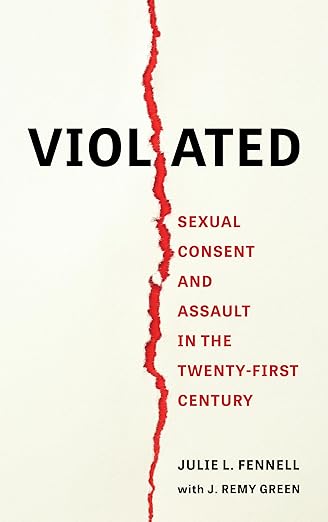
I am so excited that my new book VIOLATED: Sexual Consent & Assault in the 21st Century, with Remy Green, was recently released. My primary goal with this book is to reshape social conversations, with the secondary and idealistic goal of reshaping the law. You can read the first chapter in the sample selection on Amazon, but I wanted to make sure that everyone also had the opportunity to read the part of the conclusion that matters the most to me. Please keep in mind as you read that there is an entire book’s worth of content leading up to this, but I hope this passage will entice many of you to want to read more. And even if you don’t, that it will give you something to seriously think about. (I’m only allowed 2,000 words here by my publisher).
Sexual violation is an incredibly complex problem, and as with so many social problems, most of us instinctively want to believe there’s one magic solution that will somehow take care of the whole issue. This desire for simplicity helps breed misguided campaigns telling men, “Don’t r–e!”—as if most men were intentionally violating consent and just needed a public service announcement to remind them they weren’t supposed to do that. Of course, the naivete of that kind of campaign is also shaped by our cultural and legal failure to distinguish between intentional, knowing, reckless, and negligent acts of sexual violation [as we do with homicide].
I’ve spent a lot of time talking about the law, and I wouldn’t want anyone to walk away from this book with the impression that I think changing the law is all we need to do to fix the problem of sexual violation. I definitely hope the law changes, but my larger goal in encouraging that change is to reinforce different social perspectives and shift the broader cultural discourse, not to treat changing the law as the sole end in itself. I have very conflicted opinions about the idea of securing more convictions in an adversarial criminal justice system, with prison penalties for sexual violations. The adversarial criminal justice system seems to mostly be a grim place for victims; meanwhile, prisons themselves are one of the grimmest hotbeds of sexual violation, so it’s hard to justify the idea of reducing sexual violation overall by locking more people in them. I think the overall shape and scope of our legal system needs to change, with more focus on ideals of restorative justice, victim advocacy, legitimate concern for the humanity of criminals themselves, stopping cycles of violence, and the well-being of communities. As important as these goals are, I want to emphasize my strong belief that all those goals are more achievable if we rewrite our laws on r–e and sexual assault as described in the previous chapters than if we leave them as they are.
I think many of our social and legal struggles around consent and sexual violation come down to arguments about whether we think all sex is r–e unless someone provides consent, or whether we think all sex is consensual unless someone objects. To a large degree, there simply is no criminal parallel to sexual violation. We do not, for example, assume all slapping and choking is BDSM unless someone objects—we assume it’s assault without explicit and direct consent. Nor do we assume that, say, inviting someone into your house for a glass of water constitutes permission for them to take your television with them—we generally assume it’s theft without explicit and direct consent. But the complication here is that we mostly start with a base assumption that most people don’t want to be hit or choked, and most people want to keep their belongings—and that most men want to have sex all the time, most women want to have sex some of the time, and neither particularly wants to admit it. We have no other violent crimes that are “fun except when they’re crimes.” (Indeed, BDSM and sports like boxing are exactly the opposite, being “crimes except when they’re fun.”) So we don’t have an easy reference point for saying, “Sexual violation is like this thing over here.”
[…]
Our assumptions about equal responsibility and vulnerability [for sexual violation] have to extend beyond ideas about gender in heterosexual interactions. Even gay men seem to assume that being penetrated makes someone more vulnerable and often mistakenly imagine that men who top don’t become victims of r–e (Meyer 2022). Sexual roles don’t really provide much protection in the end because power is much more complicated than who penetrates whom. But the cultural belief in the power and protective benefits of penetration remains strong. We need to establish consistent cultural and legal standards of responsibility for sexual violation that apply to everyone—and stay cognizant that anyone’s consent can be violated—regardless of genitalia, sexual role, or gender.
No matter what criminal justice reforms we make, most of us will never sit on a jury for a sexual crime—and that’s okay, because that wouldn’t be a good distribution of our social resources in terms of people, time, or money. But due to the present state of social confusion around sexual norms in general, I think we’re going to be left with a world where sexual violations remain common for the indefinite future. Developing very good consent hygiene is a learning process, and it’s a learning process we’ve mostly left young people to muddle through on their own with little guidance from their elders. And even if we improved our guidance, we’d still have to change norms that expect so much sexual activity to occur while intoxicated. So what do we do
about all these violations in the land of sexual confusion?
Instead of sitting in a courtroom, advised by a judge, we’re far more likely to find ourselves in situations where we’re judging the actions of friends, lovers, strangers, and ourselves in informal conversations. Our responses in these everyday situations can make a world of difference in how our society comes to treat sexual violation. For example, I used to have conversations with friends that went something like this all too often:
Friend: I was r–ed last week.
Me: I’m so sorry that happened to you! Do you want to tell me more about what
happened?
Friend: [Relays a story in the context of broader physical intimacy in which a
sexual experience occurred that they didn’t want, which someone hadn’t explicitly asked them permission for, and which they didn’t try to stop]
When those types of encounters occur, most people seem to respond with a mixture of depression, guilt (because they never tried to stop it), and anger (at the other person for not asking and/or for not reading their signals correctly). I was young and inexperienced myself when I had most of those conversations, but what I wish I had said in response was, “Unfortunately, it’s normal to freeze up in those kinds of situations and not say the things you wished you’d said. That’s just the way many people respond in unexpected situations like that. Let’s get you in touch with a therapist, and see if they can help you work through your own feelings and how you want to manage things with the other person.” Alas, being young and inexperienced, I’m pretty sure what I actually said was exactly the wrong thing: “Is it really helpful to call that ‘r–e’?”
Those conversations from my youth have haunted me well into my middle age for so many reasons. For starters, I wish I’d been a more helpful friend. Lacking support after a sexual violation makes someone much more likely to be traumatized by the experience (DeKeseredy et al. 2019), and I hate feeling like I may have contributed to those traumatic cycles. But I also recognize that my failure to be supportive was due to other massive institutional failures: as discussed earlier, I went to a high school where my sex education classes began with our teacher announcing she was still a virgin and encouraging us to remain abstinent until marriage. I researched contraception on the internet myself, but I never got around to researching empathy until I was much older.
Another reason those conversations haunt me is because, like Sanyal (2018) and Hirsch and Khan (2020), I’m appalled and frustrated that Western cultures spend so little time teaching young people how to say no to sex they don’t want, in spite of considerable evidence that doing so massively reduces their chances of being sexually violated. If we think about sexual violation as a public health problem, that’s like society refusing to vaccinate teenagers against a very serious illness that could easily plague them for the rest of their lives—it is, in short, a grim waste of young lives and opportunities. And this resistance to better education is buffeted in part by our misguided belief that all “r–es” are intentionally committed by bad people instead of understanding that many “r–es” are actually committed by ignorant, intoxicated, and/or naive people who really didn’t understand what they were doing or what was happening. Using a single word and a single concept to describe both of those things obfuscates the fact that those are almost certainly two fundamentally different problems with fundamentally different solutions. Presumably the kind of violator who is a genuinely bad person is either actively excited by or really doesn’t care about violating someone’s else’s consent, while the other type of person never wanted to hurt anyone and would be horrified to know they had done so.
And that is the third reason those conversations haunt me: because I think I was technically correct in saying that framing those experiences as “r**e” was unhelpful in the broader context of personal narratives and social experiences (but that was hardly the moment to be mentioning it). These were sexual violations, to be sure, but these particular stories were exactly the same kinds of collegiate violations that Grigoriardis (2017) profiled in her book Blurred Lines, lacking the intentional malice or even reckless disregard for consent that the concept of “rape” usually implies in our culture. Grigoriardis admits that she was surprised to find in her interviews with college men who had been officially reprimanded by their universities for sexual assault that the majority were lacking malice or reckless disregard (but of course, college sexual violations may or may not be representative of the problem as a larger whole). We need more words and better concepts for framing these types of experiences. As a culture, we seem to really struggle with the idea that bad things can happen to people without it being anyone’s “fault.” This concept applies as much to sexual encounters as it does to more mundane interactions like tripping over someone and breaking your leg. In either case, it’s possible for someone to be really hurt without someone else being totally responsible for that hurt. In the case of sexual violations, survivors often blame themselves for what happened to them, which is terrible. But sometimes It’s no one’s fault they got hurt—theirs or the other person’s.
Even more confusing, we may have to acknowledge that people who feel the worst about being assaulted sometimes really do have the least “criminal” experiences, because not saying no when you felt like you should have can make you feel especially traumatized. Again, if we try to get past a judge-and-jury perspective, where everything about consent is viewed through a cultural lens of criminal justice, we can simply provide sympathy for someone who experienced a terrible but incredibly common experience without having to blame anyone or cast aspersions. It’s normal to freeze in certain sexual situations. It’s normal to occasionally make bad choices. It’s normal to fail to speak up for yourself just because you’re afraid of the social consequences or hurting someone’s feelings or looking foolish. We can validate someone’s distress in those experiences without having to turn it into a criminal case and without “blaming the victim.”
We may not sit as a jury in a box, but we often sit as a jury in a living room, and we have not been given good model instructions from a judge. We need a social vocabulary to support one another without necessarily being immediately asked to blame someone, but we also need to be able to gauge the types of offenses that probably warrant a phone call to authorities. We haven’t prepared most eighteen-year-olds well to handle these types of situations (and they’re one of the most at-risk age groups), and we also don’t give them much in the way of direct assistance from their elders. We do a lot of work to teach them to drive responsibly before they get behind the wheel of a car alone, but we do next to nothing to teach them how to fuck responsibly. We should do both.
My book is out!
My non-fiction book on the American BDSM subculture, was published by Littleman & Rowfield in 2022. The collective autobiography of the BDSM scene from 2012-17, this book is a tell-all. Check out Please Scream Quietly: A Story of Kink today!
Halloween & Slut’s Pride
Every year I hear a lot of feminist rants about the sexual objectification of women from Halloween costumes. There’s no question that American women’s Halloween costumes are often just an excuse to wear lingerie in public in a (more-or-less) socially acceptable way.
(Just in case you’re reading this and you’re not from America, here’s some context from the movie Mean Girls to tell you basically everything you need to know on this one):
Most of the rants I see take for granted that the sexual objectification of women is obviously inherently bad. I’m going to bracket that assertion for a moment and start with a point that I have never heard raised before in this discussion:
What if the real problem isn’t sexual objectification? What if the real problem is that women are only allowed to pretend to be sluts once a year even if it’s what they want to do all the time?
Any good student of culture will tell you that most long-lasting conservative cultures have rituals of escape. Indeed, often the most constraining cultures have the most surprisingly escapist rituals of all (e.g. the Amish and Rumspringa). These rituals are often only tolerated within those cultures because participants are viewed as having stepped outside of their normal social selves. The simplest, and very common, way to do that is by wearing masks or costumes (although other versions involve the use of intoxicants, religious trance or possession, or simply defining the participants as temporary outsiders as many coming-of-age rituals like Rumspringa do). But the point is that those rituals often involve people doing things that they are assumed to secretly want to do much of the time, but which normal social rules don’t let them do as regular members of society.
Sound a little bit like women dressing up for Halloween in America?
Basically, our culture assumes that women all want to be sluts all the time, but we don’t let them do it because… reasons. For all that we generally encourage women to dress much more sexually than men all the time, we don’t really let women loose sexually 363 days of the year (the other day they get some leeway for is their birthdays). Throw a costume on them, though, and suddenly women get some freedom to play a slut for a night before they go back to being their regular chaste selves.
Maybe it’s because I’m a slut all the time, or maybe it’s just because I’m genuinely hypersexual (you know, sort-of the polar opposite of an asexual). But to me, this idea is a huge problem. NOT (just) because women get all the sexual objectification for their Halloween trick/treat and men don’t, but because there’s another message coded in there: the only way you’re allowed to be a slut is if you pretend it isn’t really you. If we gave women legitimate sexual freedom the other 363 days of the year, their motivation to dress slutty for Halloween would almost certainly diminish considerably.
Before I got into the BDSM scene took up the life of a sluttastic dilettante, I always used to dress up in the sluttiest costumes I could find for Halloween–prostitutes, slutty fairies, you name it. Several years later, I usually forget to actually assemble a Halloween costume because I get to dress like that all the time (or not) if I want to… in a context where it’s way more socally acceptable and fun (see below). There’s no real thrill associated for me with “dressing up” as a slut at this point. I just get to BE one, which is waaaaaaaaay more fun.
So here’s a crazy thought: rather than criticizing the social institutions of Halloween for encouraging revealing costumes for women, why don’t we criticize the social institutions that make that so appealing for women who get stuck in carefully maintained de-sexualized lives the rest of the time when they’re not dressed up? Maybe those costumes are a fucked-up form of liberation for women who don’t get to be sexually free the remaining 99.4% of the year.
And maybe the biggest problem is that we tell women they have to pretend to be someone else before they’re allowed to be sexually free.
Okay, so I’m sure some of you reading this are still pretty pissy with me for hand-waving over the whole objectification thing, and that’s understandable. I’m going to try to address some of the key points of this huuuuuge question here, but recognize there’s a book’s worth of relevant information and analysis for this, so I’m inevitably going to miss a lot of things.
But I’m going to suggest that, fundamentally, ### “sexual objectification” is mostly only a problem based on equal opportunity, relative power, and social context. It’s not actually inherently bad.
Ack, I can feel lots of you revoking my feminist card as I write this, but hear me out, please! …I’ve got a pretty nice ass. I’ve walked down the street in short skirts. I’ve walked into bars in short skirts. I’ve stripped in a variety of contexts. And I’ve walked around kink events in everything and nothing. I’ve been ruthlessly objectified in all of those contexts, and I assure you, IT FEELS COMPLETELY DIFFERENT. It often feels a little bit gross to be objectified when you weren’t trying to do anything sexy, and it often feels downright scary in contexts where you feel like your physical safety might be in question.
But go to a kink event–where many people have gleefully pre-consented to objectification–and the experience changes dramatically. On top of that basic intentional difference of respectfully sexualized context, there’s also a much greater sense of equality: men get ruthlessly objectified as much (or perhaps even more) than women. The fact of being objectified in no way reduces someone’s social status or personal power. Finally, perhaps I’m naive, but I’ve never really worried much for my physical safety there, so objectification almost never feels like a threat.
The thing is that lots of us–both men and women–actually really enjoy being objectified. Sure, I assume that’s more common among kinky folk than the population at large, but I know lots of men and women who will guiltily confess that they enjoy being cat-called walking down the street. Many of us also enjoy being obviously checked out. It’s an ego-boost, it’s flattering, and it’s sometimes just downright funny. The problem, as I’ve said, is that even those of us who often enjoy it don’t enjoy it in all contexts: the elevator look from your waiter is not the same as the elevator look coming from your massage therapist which is not the same as the elevator look coming from your boss. Each of those scenarios changes the aforementioned dynamics of equal opportunity, relative power, and social context. (And of course, there’s always personal preference, since some people would find an elevator look uncomfortable in basically any situation).
All of this is to say that if women feel socially pressured to wear extremely revealing Halloween costumes when they don’t want to, that’s a big problem. It’s also a problem if women keep getting put on sexual display in contexts where a. Men aren’t b. Women feel disempowered in general and disempowered sexually in particular and c. Women feel unsafe. But change the fundamental composition of the social context, so that things look more like the world of the BDSM scene, and I really don’t think that sexual objectification is a big problem. I realize that the rest of the world doesn’t look like the BDSM scene, but I sure as hell want it to.
Notice that a huge part of why the sexual objetification of women is such a big problem most of the time is that women often feel like there may be serious consequences for refusing OR accepting blatant sexual advances. When those consequences are vastly reduced–and when a culture shifts from slut-shaming to slut-embracing as the BDSM culture has attempted to do–then a lot of the underlying fear that accompanies sexual objectification mostly kind of goes away or becomes irrelevant. And when women feel empowered to objectify men too, the sense of threat likewise diminishes.
… All of which is to say, I don’t think the problem is objectification itself. The problem is all the social baggage around it.
In sum: stop criticizing Halloween costumes for being sexually revealing. Criticize social pressure to don said costumes, by all means. But remember that the bigger problems are that society makes women put on a disguise to be slutty and really only lets them do it once a year, and that the problems associated with sexual objectification are more about the social context of that objectification than objectification itself.
Change the fucking social context, not (just) your clothes.
And if you want to start an odd sort of revolution, ladies, try wearing your sexy-ass Halloween costumes all the fucking time. That’s what I do. Trust me, it’ll seriously fuck with the social norms in ways you’d never expect.
The 8 Most Misunderstood Things About BDSM
It’s easy to mock and misunderstand kinky people. We’re weird. I know. Trust me, only kinky people know how really weird we are. But seriously, most of us aren’t that weird, especially compared to say, soccer moms. Everyone deserves to be laughed at for something, and it’s easy to poke fun at kinksters. But if you’re going to laugh, please laugh about the right things. The stereotypes and misunderstandings that “vanillas” (what kinky people call everyone else) have about us undoubtedly exceed the 8 things on this list. Lo, these misinformed stereotypes even recently appeared in a cracked.com article. We already have to deal with the fictional travesty that is 50 Shades of Grey, with its dubious conceptions of BDSM and its lexically challenged heroine. So please take a minute to learn how most of what you’ve learned about BDSM is wrong.
8. “What the hell is that acronym for anyway? Can I just call it ‘kink?’”
The acronym cheats: “BDSM” actually stands for 6 things—Bondage & Discipline, Dominance & submission (and yes, kink orthography traditionally capitalizes the “D” and doesn’t capitalize the “s”), and Sadism & Masochism. The acronym evolved over time from S&M to SM to BDS&M to just plain BDSM. Expect it to change again in 10 years.
And yes, you can just call it “kink.” Kinky people do. Just don’t be a judgmental prick about it.
For a good summary of the history, see CARAS research
7. “All kinky people wear leather. And are gay.”
Long, long ago, there was a “leather scene” primarily for gay men that involved many activities that we now tend to label BDSM. Then some straight-ish people saw what was going on and thought that that kinky shit looked fun and started building their own BDSM subcultures. To this day, gay men and… everyone else… functionally have two separate, albeit related BDSM worlds. Occasionally, we all get together at big events, but for the most part, the “pansexual” BDSM scene and the “gay men’s leather scene” are basically distinct.

Gratuitous hot boys in leather.

Well, kinky girls wear weird shit too… it just isn’t always leather: gratuitous hot chick in latex.
Nowadays, all kinksters have the same flag, but the not-gay male kinky people are a lot less likely to wear leather.

“No flag, no subculture–that’s the rule that I just made up!” ~with apologies to Eddie Izzard
References: Fennell 2014 Lenius 2001 Richters et al. 2008 (for Australia)
6. “All people who do BDSM participate in ‘The Lifestyle’”
The public face of BDSM tends to be folks who are out, loud, and proud.

Awww, so cute! This was the #2 picture when I searched google image for “BDSM.”
Cute pic, right? But in reality, you won’t find most kinksters at a pride parade or at their local BDSM “munch” or happy hour (those are kinky social networking events, FYI), or even at the local BDSM club. Despite the visibility of public kink, social scientists actually assume that the vast majority of people engaging in kink are not part of the public BDSM subculture (usually referred to as “The Scene” or “The Lifestyle”).

It’s like facebook, except there are lots of naked pictures.
The BDSM subculture (which is most visible on the internet on the website FetLife) only represents a tiny fraction of kinky folks. Only a few kinky folks are lucky enough to live in a big city with a public BDSM scene. But even a lot of those people don’t like getting dressed up, going to parties, and doing kink surrounded by lots of other people. The public BDSM scene calls to exhibitionists and people who like doing weird things in the company of other weird people. These people also tend to be white and middle+-class.
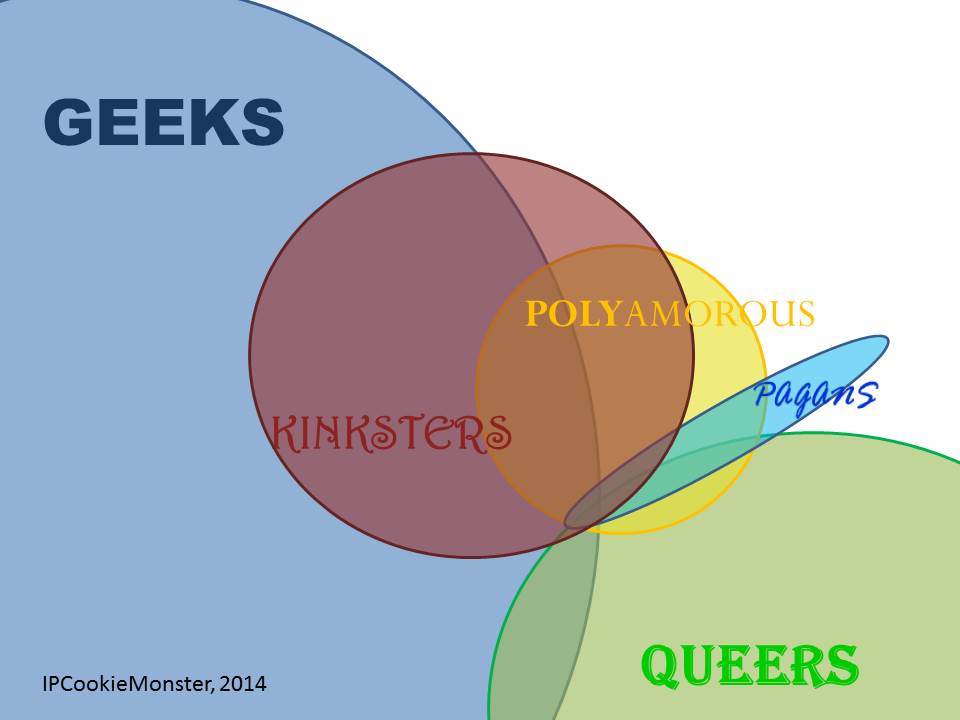
I created this diagram to illustrate my point.
People who participate in the public BDSM scene tend to participate in a lot of overlapping and adjacent subcultures as well, most notably the geek subculture, the pagan subculture, and the polyamorous subculture. Polyamory??? You know, that crazy thing where people get to sleep with people who aren’t their spouses, but don’t lie about it… or have meaningful relationships with lots of people… or some combination of the above.

Polyamorous life is definitely more complicated, but it’s also a helluva lot more fun.
Most people who participate in the public BDSM scene in the main urban areas around the U.S. are non-monogamous, while we’re pretty sure the people who like to play at home have more traditional monogamish relationships.

I can’t be wittier than Oscar Wilde.
In the public BDSM scene where I live, monogamous kinksters were so rare that they tried to set up their own dating group. But there were so few of them that it rapidly vanished.
References: Newmahr 2010 Sheff & Hammers 2011
5. “Kinksters and swingers are all part of the same subculture”
Au contraire, there is actually a longstanding subcultural war between kinksters and swingers, even though—nay, perhaps because—they often have their events in the same venues on alternating nights. The hostility is so common that the primary group for swingers on the kinky social networking website FetLife is defensively named, “’Swingers‘ is not a dirty word!”

#3 google image pic for “Swinger Party.” Real swingers tend to be a lot older than this, but just as white, and just as naked.

The only google image I could quickly find for “BDSM Party” that wasn’t from porn. As you see, sexy, but a lot less sex. Real kinksters tend to look pretty much exactly like this—just as white and just as semi-clothed, most of the time.
To be clear, kinksters like to play with power and pain; swingers like to have sex with lots of people. These desires occasionally overlap, but mostly don’t.
Many kink gatherings forbid sex; sex is what happens at swinger parties. Most kink events enforce strict rules about consensual touching; most swinger events operate with a “touch unless swatted” attitude. Many kink events are extremely Queer-friendly (despite a decidedly heterosexual male/bisexual female bias); most swinger events strongly discourage two men from staring at each other’s asses, let alone fucking.
Reference: Morton 2010
4. “All kinksters live in 24/7 Dominant/submissive relationships and do crazy shit like play with enemas and let people pee on them.”
Whoa, there, friend! Um, some of us do… but actually, the vast majority of us don’t.

Don’t gay guys dress like this all the time?
Just like the gay guys who make the news are often wearing rainbow tutus with sparkly underwear, the people who are conspicuous among kinky folk tend to live at the extremes—but neither is really representative of “most gay guys” or “most kinksters.” Most kinky folks aren’t in 24/7 relationships, have never signed a contract that lets someone else “own” them, and wouldn’t let someone else pee on them.

Lots of kinky people get collared or collar someone else. Most of us don’t.
Sure, lots of kinky people have done all of these things, but your average kinky person likes being tied up and beaten with a flogger on weekends, not wandering around on a leash and eating from a dog bowl in their spare time (not that I’m judging those people—those people totally hot and cool, and I sleep with plenty of them, but they’re still not the average). On Fetlife, discounting oral sex (#2) and anal sex (#5), the 10 most popular “kinks” are: bondage, spanking, hair pulling, blindfolds, biting, talking dirty, handcuffs, discipline, collar lead/leash, and lingerie.
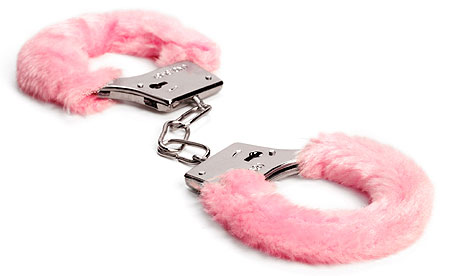
Handcuffs: so kinky you can buy them at the mall at Spencer’s, along with a Superman wallet.
Reference: for Sweden: Carlstrom 2012
3. “All kinky people were abused as children, or have been raped or molested.”
This one just won’t go away: the great kinky romantic comedy Secretary actually opens with the main character being released from a mental hospital; meanwhile Christian Grey in 50 Shades of Grey has some sort of tortured past of non-consent. Just like psychologists used to try to expend a lot of energy and imagination trying to figure out the experiences in someone’s past that “makes them gay,” the culture still tends to assume that some experience “makes them kinky.”

Dude, Mama Monster (Lady Gaga) said she was Born This Way. Why would she lie?
Despite the persistent idea of kinksters with haunted pasts of abuse and molestation, in fact, psychological research has found over and over again that kinksters are pretty damned normal and as likely to have been raped or abused as anyone else. A lot of kinky people say they were just born this way, with some suggesting that “kinky” is a basic sexual orientation the same way “straight” or “gay” is.
References: Meeker Connolly 2008 Wismeijer & van Assen 2013 (the Netherlands) Richters et al. 2008 (Australia)
2. “All Doms are men” OR “All Doms are women”
Both of these misconceptions manage to float around simultaneously. The idea that all Doms are women is fueled by the fact that most professional dominatrixes are women.
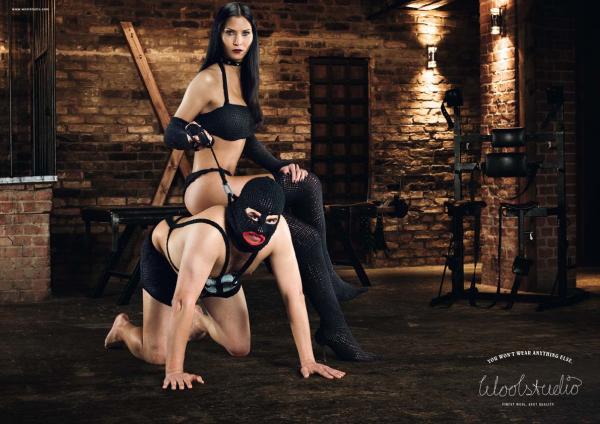
It’s a living.
The idea that all Doms are men is driven by sexist assumptions about women all being submissive and having a deep-seated biological urge to spread their legs whenever anyone with a penis tells them to.

You can regularly meet people in the BDSM subculture who will assure you that all women are “really” submissive, and all men are “really” dominant… although they have an awkward habit of spelling the adjective “dominate.”
Nevertheless, the idea that men are Doms and women are subs turns out to have a little validity: inside the BDSM subculture, women are much more likely to be submissive than dominant. However, in defiance of popular imagination and BDSM imagination both, about a third of men identify as submissive, and switches (people who like to be dominant and submissive) of both genders are quite common.

It’s called “switching.” It’s not surprising that mainstream imagination tends to forget its existence, since the BDSM subculture tends to forget about it too.
References: Lindemann 2010 Wismeijer & van Assen 2008 (the Netherlands) Bienvenu, McGeorge, Jacques 2002
1. “It’s all about sex”
This pseudo-myth actually gets debated a lot among people in the BDSM subculture themselves. Witness the following:

I admit I find this attitude pretty funny myself, but it’s kinda popular.
In wild contrast to the porntastic popular portrayal, many kinksters say that BDSM isn’t about sex at all, and it’s common for public kink parties and gatherings to forbid any sexual activity. When I interviewed American east coast kinksters, about 25% of them said that kink wasn’t sexual for them personally, and that they didn’t think it was sexual in general.
It may seem really counterintuitive, but lots of people do BDSM the way that other people climb mountains—like an extreme sport. Many people report the same kind of endorphin high from getting whipped, beaten, tied up, etc. that other people report from running, rock climbing, etc.

This looks pretty fucking kinky to me. That’s some serious bondage.

In case you were wondering, people don’t usually fuck when they’re tied up like this.
Other people really do engage in BDSM as a religious/spiritual activity, and psychologists have shown that participants’ bodies actually respond in ways that echo those of a person having any other type of religious experience to these rituals.
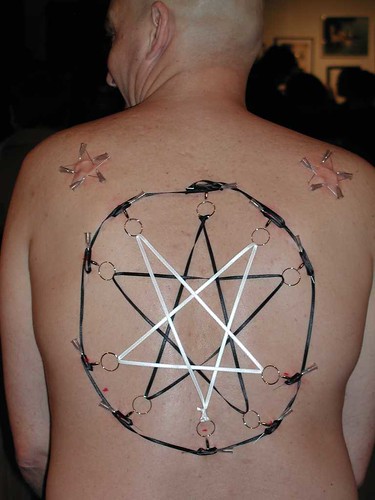
BDSM can turn your body into a religious work of art. I wouldn’t recommend having sex like this, but you theoretically could…
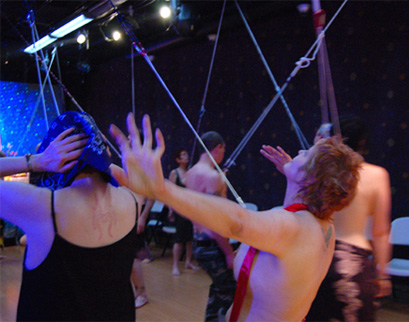
Kink, religion, or both? If the people weren’t white, would your answer change?
References: Newmahr 2010 Livescience Fennell 2014

***********************
Please note: none of these photos except the diagram in the middle are original to me. All are live-linked back to their original sources. Enjoy!

 Slut, Ph.D.